
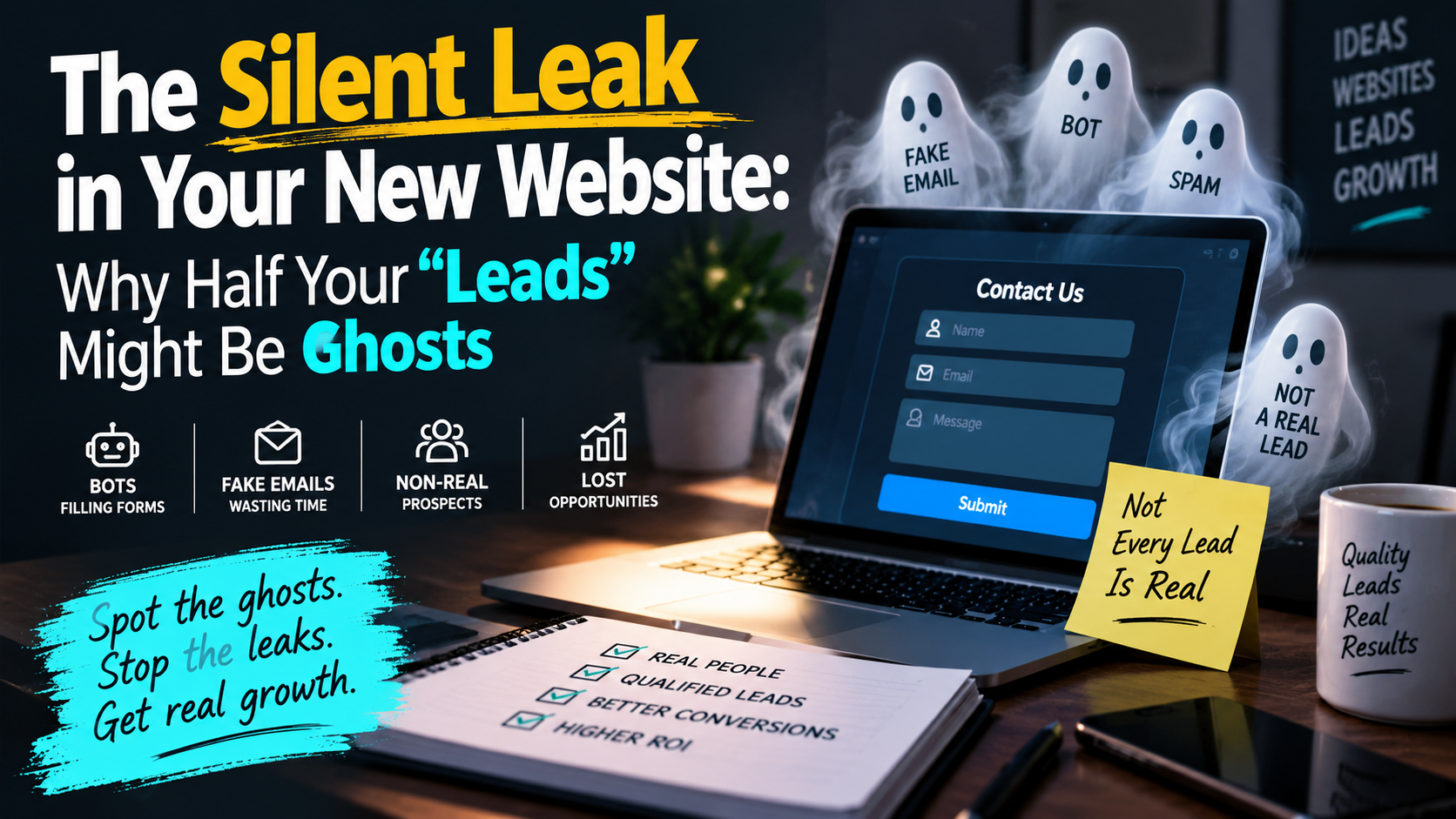
You finally launched the website. The contact form works, the analytics are ticking up, and a few form submissions and newsletter signups have started rolling in. It feels like the investment is paying off.
Then you actually try to follow up. The emails bounce. The “leads” never reply. The newsletter you send lands in nobody’s inbox. And slowly it dawns on you: a chunk of your shiny new numbers aren’t people at all. They’re ghosts.
This is one of the least-talked-about problems in small business websites, and it quietly costs owners time, money, and — worst of all — bad decisions. Because when your data is polluted, you don’t just lose a few fake entries. You start steering your whole business by a broken compass.
Let’s talk about where these ghosts come from, why they matter more than you’d think, and what you can actually do about it.
Meet the Disposable Email
The single biggest source of ghost leads is the disposable, or temporary, email address.
If you’ve never used one, here’s the idea. Disposable email services give anyone a working, real-looking inbox that self-destructs after a few minutes or hours. People use them for perfectly reasonable reasons — to grab a one-time discount code without handing over their real inbox, to download a free guide without signing up for a lifetime of marketing, to test something, or simply to avoid spam. From the user’s side, it’s a convenience and a privacy shield, and there’s nothing sinister about it.
But from your side — the business collecting that email — a disposable address is a landmine. It looks completely valid at the moment of signup. It passes the basic “is this a real email format” check. It lands in your database looking exactly like a genuine lead. And then, minutes later, the inbox on the other end vanishes into thin air, taking any hope of follow-up with it.
Multiply that across every “get 10% off,” every gated download, every “subscribe for updates” on your site, and you start to see the scale of the problem. You didn’t get a lead. You got a costume.
Why This Is Worse Than It Looks
“So a few fake emails slip in — who cares?” Here’s who cares: anyone trying to run a business on real information.
Your follow-up falls apart. The entire point of collecting an email is to continue the conversation. A disposable address breaks that on contact. Every automated welcome sequence, every “thanks for your enquiry, here’s how we can help” email, every gentle nudge to book a call — all of it fires into a dead inbox. You built a follow-up system and half of it is talking to nobody.
Your email reputation takes damage. This one is sneaky and genuinely harmful. When you send emails to addresses that no longer exist, they bounce. Email providers like Gmail and Outlook watch your bounce rate closely, and a high bounce rate tells them you’re either careless or a spammer. The result? Your good emails — the ones going to real, interested customers — start landing in spam folders instead of inboxes. A pile of dead disposable addresses doesn’t just waste your time; it actively sabotages your ability to reach the people who matter.
Your numbers start lying to you. This is the deepest cost. Say your site generated 200 “leads” last month and you’re thrilled. But 80 of them were disposable-email ghosts. Now your conversion rate is secretly a fiction, your cost-per-lead is wrong, and — if you’re spending on ads — you’re optimizing your campaigns toward whatever’s attracting the most ghosts, not the most customers. You make a confident decision based on the data, and the data was rotten. Bad information is more dangerous than no information, because it feels like knowledge.
Your team wastes real hours. If you or a staff member manually work through enquiries, every ghost lead is minutes spent crafting a reply, waiting, following up, and eventually giving up — on someone who was never there. For a small team, that adds up fast.
Your promotions get abused. If you run a “first order free” or a downloadable resource behind an email gate, disposable addresses let the same person claim it over and over with a fresh throwaway inbox each time. The offer you designed to win new customers becomes a faucet that freeloaders leave running.
A Tale of Two Contact Forms
To see how much this matters, picture two small businesses that launched near-identical websites in the same month.
The first owner watches the signups roll in and celebrates. Two hundred leads! She pours her energy into volume — more ads to drive more form fills, a bigger discount to pull more signups. The number keeps climbing and she keeps spending against it. What she can’t see is that a growing share of those entries are disposable-email ghosts, drawn in precisely because the discount is generous and the form asks for nothing that can’t be faked. Her cost-per-lead looks fine on paper, so she scales the spend. Months later, revenue hasn’t moved, her email sends are landing in spam, and she can’t figure out why a “successful” website isn’t producing customers. She’s optimized her entire funnel toward attracting ghosts.
The second owner gets fewer signups — maybe ninety instead of two hundred — because he filters disposable emails at the door and uses a confirmation step. Every name on his list is a real, reachable person. His follow-up emails actually arrive. His conversion rate reflects reality, so when he decides where to spend, he’s steering by a true map. He grows slower on the vanity metric and faster on the only metric that pays the bills: paying customers.
Same website. Same month. Same budget. The difference wasn’t design or luck — it was whether the data coming in was real. That’s the whole game.
How to Tell If You Have a Ghost Problem
You don’t need fancy tools to get a first read on this. A few signs your website is collecting ghosts:
- Your email bounce rate is climbing, especially on newer contacts.
- You’ve got form submissions or signups that never, ever reply — not even to say “not interested.”
- Your signup numbers look great but your actual sales or bookings don’t move in step.
- You notice odd-looking email domains in your list that you don’t recognize.
- The same offer keeps getting claimed by suspiciously similar new signups.
If two or three of those ring true, you almost certainly have disposable emails in your funnel. The good news is that it’s a very fixable problem.
What You Can Actually Do About It
You can’t stop people from owning disposable emails — nor should you want to police that. What you can do is stop letting them quietly poison your business data. A few practical layers, from easiest to most robust:
1. Filter disposable domains at the point of signup. This is the highest-leverage fix. Disposable email providers use known, identifiable domains, and email verification tools can spot them the instant someone hits “submit” — flagging or blocking the throwaway address before it ever contaminates your list. The person can still use your site; they just can’t hand you a self-destructing inbox as their contact detail. This single step removes the majority of the problem at the door.
2. Use double opt-in for your email list. Instead of adding a signup straight to your list, send a confirmation email they have to click. Disposable inboxes are usually gone before that click ever happens, so the ghosts filter themselves out automatically. Your list ends up smaller but dramatically healthier — and a small list of real humans beats a big list of bounces every single time.
3. Add light friction to high-abuse offers. For anything valuable behind an email gate — free trials, discount codes, downloads — a small verification step or a limit per address discourages the throwaway-and-repeat pattern without annoying genuine customers.
4. Clean your existing list. If you’ve been collecting emails for a while, run your current list through a verification pass to remove the dead addresses already in there. It’ll instantly improve your deliverability and stop you sending into the void.
5. Watch the right metrics. Track your bounce rate and your reply/engagement rate, not just raw signup counts. A signup number that goes up while engagement stays flat is the classic signature of a ghost problem. Real leads do things — they open, click, reply, show up. Ghosts just inflate a number.
“But Won’t Filtering Block Real Customers?”
This is the fear that stops a lot of owners from doing anything — and it’s worth addressing head-on, because the fear is bigger than the reality.
Blocking disposable emails is not the same as blocking privacy-conscious customers. A genuine customer using their normal Gmail, Outlook, company, or personal domain sails straight through — verification tools target the specific, known throwaway domains, not ordinary inboxes. The person who’s actually interested in your service almost never reaches for a self-destructing address to contact you; they want you to be able to reply. The throwaway inbox is, by design, for people who don’t want a relationship. Filtering it out mostly removes the contacts who were never going to convert anyway.
Could you occasionally lose a real signup who happened to use a disposable email out of habit? Rarely — and even then, it’s usually someone grabbing a freebie, not someone ready to buy. Weigh that against the daily cost of polluted data, wrecked deliverability, and wasted follow-up, and the trade is lopsided in your favor. You’re not building a wall around your business. You’re putting a doormat check at the entrance so the people who come in are actually people.
The gentlest version of all — double opt-in — sidesteps the worry entirely. You’re not blocking anyone at all; you’re simply asking them to confirm. Real people click. Ghosts can’t. Nobody genuine is turned away, and the fakes filter themselves out. If you only do one thing from this article, that’s the safest place to start.
The Bigger Lesson: Protect the Quality of Your Data
Step back and the theme is bigger than email. A website’s real value isn’t the traffic number or the signup count you can screenshot for a WhatsApp status. It’s the quality of the connections it creates with real people who might actually become customers.
Every ghost in your database is a small lie your own website is telling you. One or two won’t hurt. But left unchecked, they compound — a little damage to your email reputation, a little wasted staff time, a little distortion in your numbers — until you’re running your business on a picture that’s subtly, persistently wrong.
The businesses that win online aren’t the ones with the biggest lists. They’re the ones with the cleanest ones — a database where a “lead” means a real human on the other end, where your follow-up actually reaches someone, where your conversion rate is telling you the truth. That’s a foundation you can build on. A list full of ghosts is a foundation of sand.
The Takeaway
A beautiful website that collects garbage data isn’t doing its job — it’s just doing it convincingly enough to fool you. Getting more traffic and more signups is only a win if those signups are real, reachable, and worth your time.
So as you celebrate those first form submissions and newsletter signups, ask the harder question underneath the excitement: are these real people I can actually build a relationship with, or am I filling a database with ghosts?
Put a few simple filters in place at the front door — verify emails at signup, use double opt-in, watch engagement over raw counts — and you protect the one thing your website exists to produce: genuine connections with genuine customers. Everything else is just numbers, and numbers you can’t trust are worse than no numbers at all.
Your website should be a lead machine, not a ghost trap. The difference comes down to whether you’re guarding the quality of what comes in — or just counting it.